
This entry is descriptive of the FOLLOWING CATALOGUE NUMBERS:
T.GB.1860.6
GB.1860.6A

THIS MICROHISTORY TAKES PLACE ON OR INVOLVES THE ANCESTRAL LANDS OF THE Cayuse, Umatilla, and Walla Walla and Nisenan PEOPLES OF CALIFORNIA.
(JUMP TO ARTICLE TRANSCRIPTIONS)
This microhistory demonstrates a relationship between multiple bears and likely involves a family unit. GB.1860.6A was a subadult male Grizzly or North American Brown Bear killed in the vicinity of Antelope Creek, a fresh water tributary of the Sacramento River system in or near Tehama County near Red Bluff, California in the United States on or about April 28, 1860 by a hunting party comprised of multiple men including Jeff Hickman, Gus Moore, and an unnamed third. GB.1860.6A was the cub of T.GB.1860.6, an adult female Grizzly or North American Brown Bear who survived the encounter but was badly wounded. T.GB.1860.6‘s mortality outcome is unknown beyond the events of this microhistory. As the events to which this microhistory refers describe the death of one Bear and the escape of another, GB.1860.6A has been assigned a Unique Animal Number (UAN) and T.GB.1860.6 has been designated as a Tracks entry. The encounters which this microhistory represents impact one or more predator agency physically, and are classed as Tier 1 events.

The story was first published by the California newspaper the Red Bluff Beacon and was later recirculated in the Daily National Democrat, the Sacramento Daily Union and the Nevada Journal.1 This microhistory has a relationship to human injury but no known relationship to human fatality. It involves severe injury to Moore’s arm and hand. Later microhistorical reference to the loss of Moore’s arm may interlink with the microhistory of GB.1860.6A.2 Select narratives involve thematics relating to nineteenth century conceptions of heroism. Reference to a rifle ball may represent poetic license on the part of the journalist or may contextualize the firearm used to kill GB.1860.6A by Hickman as a rifled musket.
While the motivation for this hunt is unknown, that the hunters “fell in with” GB.1860.6A and T.GB.1860.6 suggests that this microhistory should be considered alongside others involving hunts motivated by pursuit of other animals. The possible presence of local, relevant prey species should be considered. However, the involvement of Moore is notable in that his orchestration of guided sport or trophy hunts for Grizzly bears in this area of northern California appear elsewhere in the record. Future context on Moore’s relationship to this ecology may alter how this microhistory is classified and may further describe regional hunting deaths in relation to the environmental or social stressors experienced by a broader local population. Considering this microhistory alongside those involving other social groups of the American west may further describe these interlinkages.

While length data is unknown for both GB.1860.6A and T.GB.1860.6, and weight data is unknown for T.GB.1860.6, weight data is known for solitary known cub GB.1860.6A and is stated as being 200lbs (92kg).
GB.1860.6A and T.GB.1860.6’s microhistory contributes alongside others for which offspring outcomes are known. In particular, this microhistory’s association with maternity, as well as the advanced age and otherwise-unspecified poor health or condition of T.GB.1860.6, should, alongside her severe wounding and death of her offspring, prompt consideration of this microhistory’s relationship to impacts on maternal health.
This microhistory’s relationship with seasonality offers dialogue with the period of den emergence following the winter rest period (torpor sleep, or “hibernation”) and the subsequent period of normal activity in early spring and spring.3 Its locus in the California Central Valley Grasslands ecoregion or California Interior Chaparral and Woodlands ecoregion, and the Mediterranean Forests, Woodlands and Scrub biome and Temperate Grasslands, Savannas, and Shrublands biome may suggest dialogue with historical populations of the California Grizzly, an extinct subtype of North American Brown Bear with critical relationships to 19th Century settlement.4
This microhistory has no known association to bloodsport, is not known to involve domestic or companion animals, livestock animals, or incidents of further human retaliation.
Click to expand article transcription(s)
“A Bear Fight,” Red Bluff Beacon , May 2 1860.
“A party of gentlemen, from Antelope, were out hunting last week, when they fell in with an old bear and a cub—the latter weighing some two hundred pounds. Mr. Moore was attacked and pretty roughly handled by his cubship, and had not one of the party released his grip by a rifle ball, he would have breathed his last in young bruin’s embrace ; as it was, he came off with a badly mangled thumb and fingers, and a few minor wounds. Jeff Hickman crippled the old bear, but in the excitement of relieving their companion, and killing grizzly junior, grizzly senior sagaciously placed a safe distance between herself and danger, thus saving her hide and tallow for another occasion. Our informant says it was the roughest squabble he ever participated in.”
“Bear Fight,” Sacramento Daily Union, May 4 1860.
“A man named Moore, who was out hunting with a party on Antelope creek, fell in with a grizzly bear, who nearly hugged him to death.”
“Correspondence,” Nevada Journal, June 22 1860, June 22 1860.
“At sunrise we left our cabin, and keeping down the left bank of the Little Truckee for some seven miles (ten miles from the Webber cabins and seven from Maples Ranch) when we turned abruptly to the left up a ravine about a mile long and reached Moore’s Ranch at the head of the ravine, where we took breakfast […] There are plenty of grizzlies in this vicinity and Moore, (who is a good fellow and a “mighty hunter,” notwithstanding the loss of an arm,) promised to show me some good sport if I could sure time on my return, in the line of grizzly hunting—he had just killed one of the animals a day or two before. Moore’s to Sardine Valley is six miles — a good wagon road over gentle swelling hills and through beautiful parks of trees—mostly pine. At Sardine Valley a large and substantial building is in process of erection, and here are more delightful meadows and brooks.”
“Independence Lake, or Scenery of the Sierras,” Sacramento Daily Union, July 19 1862.
“Did you ever hear of Gus. Moore— Gus. Moore the Mountaineer? well, he is a genius, and you know that true genius is not confined to wealth or position in life. Colleges and cities have not produced all the original and marked med of this or any other age; and men of sterling talents may be found who know nothing of the dead languages, or classics, and who cannot construe ab from [abdomen]— and then, too, there is a different range of genius. Some shine in the pulpit, some at the bar, some as politicians, and some like Beau Brummel, in the fashion-able world. But Gus. Shines in neither of these; in fact, while he don’t try to shine at all, he shines as a bold mountaineer. Tall, athletic, but spare in form, he stands before you a hardy, good natured, but resolute, well informed man, and a glance will tell you he is a marked and original character. I took a fancy to him the minute I saw him, and further acquaintance justified my predilections. He is one of the best rifle shots I ever saw. He can do as much work as any other man; can ride a wild horse, play a bo-peep game for life or death with an Indian, meet a fierce grizzly with his hunting knife, hunt, fish, chip, dance — in short, do all that any wide-awake, go-ahead man can do, as well as the best; and yet, reader, Gus. Moore has but one arm. There is scarcely a stump left of the other, yet that stump will do more for him than some men can do with both arms. Ask him how he lost it — perhaps he’ll tell you it was bit off. You look incredulous — he may add, “Oh! It was when I was asleep;” and then if he doesn’t choose to enlighten you, why — I shan’t. He has had severe combats with Indians, in which he came out with a whole skin, while more than one of his foes went to their Spirit hunting grounds, but his great deed was killing a grizzly bear with his hunting knife, and coming out of the encounter with scarcely a scratch. I will not steal his thunder by telling the story, but leave it for him when you go to his cheerful home at Tule lake, on the Henness Pass road.”
Notes
- “A Bear Fight,” Red Bluff Beacon, May 2 1860, Volume 4, Number 7, Page 3 (Red Bluff, CA); “A Bear Fight,” Daily National Democrat, May 4 1860Volume 4, Number 71 (Marysville, CA); “Bear Fight,” Sacramento Daily Union, May 4 1860, Volume 19, Number 2841, (Sacramento CA).
- “Correspondence,” Nevada Journal, June 22 1860, Volume 11, Number 7 (Nevada City, CA) states: “there are plenty of grizzlies in this vicinity and Moore, (who is a good fellow and a “mighty hunter,” notwithstanding the loss of an arm,) promised to show me some good sport if I could sure time on my return, in the line of grizzly hunting—he had just killed one of the animals a day or two before.” Likewise, “Independence Lake: Or, Scenery of the Sierras,” Sacramento Daily Union, 19 July 1862, Volume 23, Number 3528 (Sacramento CA) relates: “Ask him how he lost it — perhaps he’ll tell you it was bit off. You look incredulous — he may add, “Oh! It was when I was asleep;” and then if he doesn’t choose to enlighten you, why — I shan’t.“
- For more details, see “5 Stages of Activity and Hibernation.” North American Bear Center.
- Alexis M. Mychajliw et al., “Coupled Social and Ecological Change Drove the Historical Extinction of the California Grizzly Bear (Ursus arctos californicus),” Proceedings of the Royal Society B: Biological Sciences 291, no. 2014 (2024): 20230921.
Cite This Page:
Chicago
Caroline Abbott. “T.GB.1860.6; GB.1860.6A.” Predator Microhistory Network. [Accessed Month, Day, Year].
MHRA
Caroline Abbott, ‘T.GB.1860.6; GB.1860.6A’, Predator Microhistory Network. [Accessed Day Month Year]
MLA
Abbott, Caroline. “T.GB.1860.6; GB.1860.6A.” Predator Microhistory Network, 1 October, 2025. [Accessed Day Month Year].
APA
Abbott, C. 2025, October 1. T.GB.1860.6; GB.1860.6A. Predator Microhistory Network.
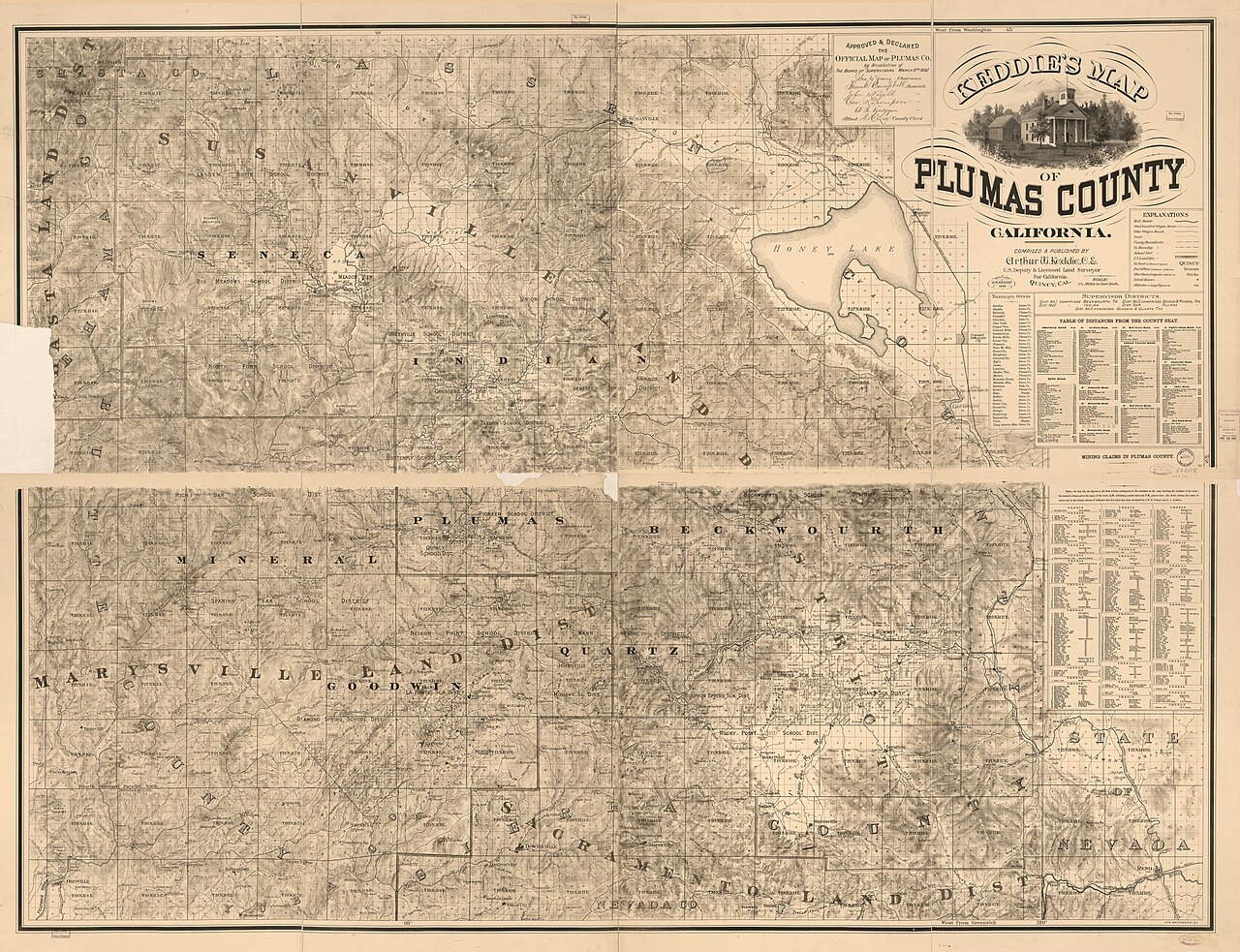
Feature Image: Keddie’s map of Plumas County, California. 1892. LOC 2012592094-1. Shelf ID: G4363.P6 1892 .K4. Public Domain. Accessed via Wikimedia Commons.
