
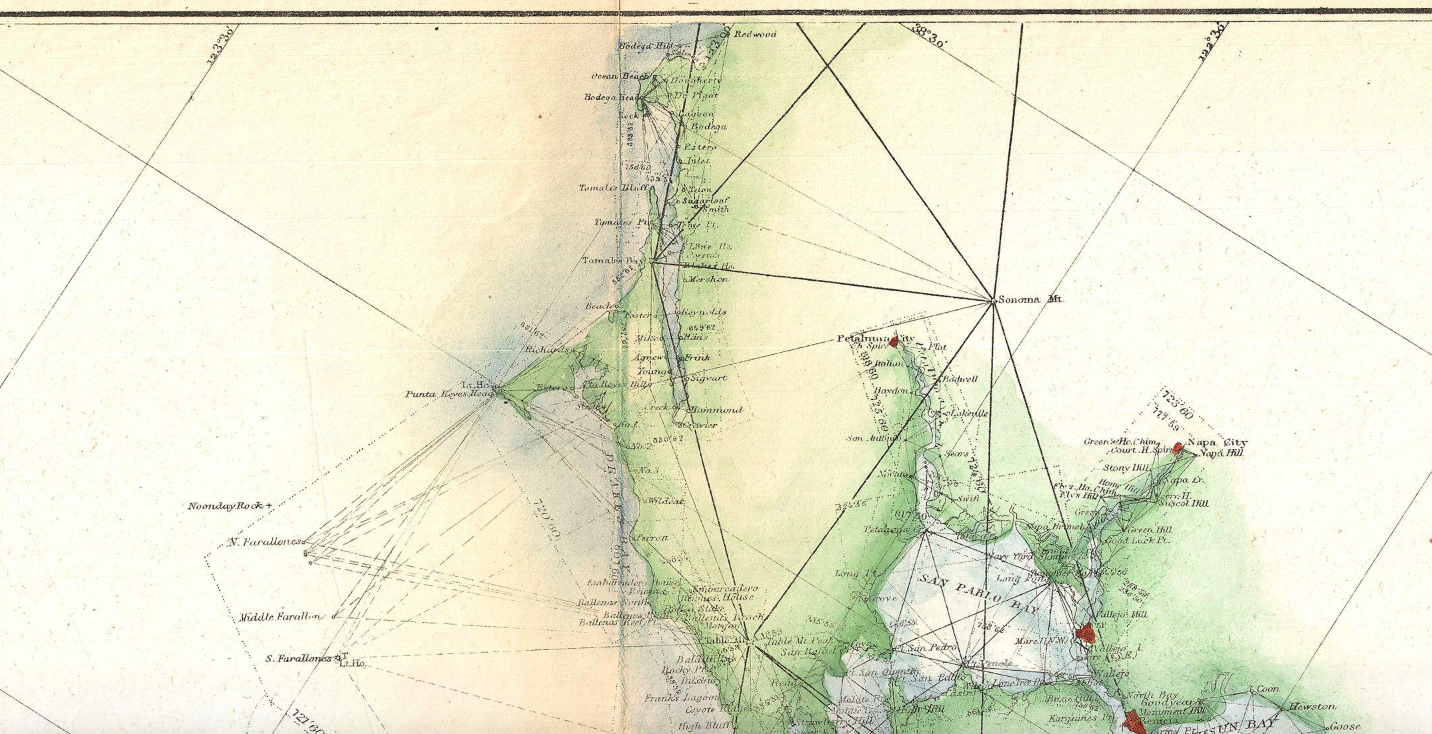

This microhistory takes place on or May involve the Ancestral lands of the Graton Rancheria, Miwok (Miwuk; Mi-Wuk; Me-Wuk) People , including the Me-Wuk (Coast Miwok), Peoples of California.
(Jump to Article Transcriptions)
(Jump to events related to GB.1860.7 from 1850-1859)
GB.1860.7: 1860:
GB.1860.7, or “the Big Bear of Marin,” was a large adult male, named, known or “celebrity”, Grizzly Bear or North American Brown Bear killed in Marin, (Sonoma County,) California in the United States on June 8, 1860 in retaliation for numerous instances of proximity to and predation upon, livestock animals resulting in death and injury to cattle and hogs.
The events of 7 and 8 June, 1860 represent a microhistory which impacts one or more predator agency physically, and have so classed been classed as Tier 1 events. The events of 9 and 10 June, 1860 represent a microhistory which is descriptive of “sign” of a predator population or individual, or which involves individual predators deceased prior to the encounter, but in which no physical encounter occurs, and are so classed as Tier 3 events. As an encounter which describes an animal’s death and through which other microhistorical tracks can be attributed to this animal’s agency, this Bear has been assigned a Unique Animal Number (UAN). The story was widely published in California newspapers including the Daily National Democrat, Hydraulic Press, Petaluma Journal, Sonoma County Journal, Marysville Daily Appeal, and the Sacramento Daily Union.1

June 7 1860:
A predation event upon livestock animals occurred on June 7 1860 on the ranch of Mr. J. S. Bracket on Salmon Creek during which a hog was killed by GB.1860.7. GB.1860.7 survived Bracket‘s retaliation and escaped, but may have been wounded.
June 8 1860:
On June 8, 1860 a hunting party of six men including V. Bonnard, J. S. Bracket, T. H. Estey and C. L. Estey, Jules Poirsson, S. Steadman, and one Cooper initiated retaliatory pursuit and began tracking GB.1860.7 through a wooded area. GB.1860.7 charged V. Bonnard, whose attempts to fire on GB.1860.7 failed, at which point T. H. Estey fired on GB.1860.7, wounding GB.1860.7, who was then killed by the hunting party. While Mons. Bonnard (who may have represented the French settlers of the American west) sustained injury to his left arm, this event has no relationship to human fatality.

June 9 1860:
On June 9, 1860 the body of GB.1860.7 was brought to Petaluma. GB.1860.7 weighed 1,140lbs (517kg). No length data is currently known.
June 10 1860:
On June 10, 1860 the body of GB.1860.7 was brought to San Francisco, “where the lovers of “bar meat” no doubt had an opportunity to gratify the taste to their full content,” correlating the history of GB.1860.7 with the commodification or consumption of predator meat.

This microhistory involves both fresh and salt water bodies typical of the Marin Hills, in particular, the involvement of the Salmon Creek watershed. The involvement of the Salmon Creek and its associated settlement suggests that while local, relevant prey species are not referenced, in conjunction with the summer season’s period of normal activity following winter rest in North American Brown Bears, their presence or the impact of their historical presence may be implied, particuarly given the California Coast Ranges historical relationship with salmon.2 These relationships can be better understood in dialogue with this microhistory’s occurrence in the Northern California Coastal Forests ecoregion and California Interior Chaparral and Woodlands ecoregion, as well as their associated Temperate Conifer Forests biome, and Mediterranean Forests, Woodlands and Scrub biome. The geographic locus of this microhistory may suggest dialogue with the history of the California Grizzly, a larger, extinct subtype of Grizzly or North American Brown Bear with critical relationships to nineteenth century settlement and extractivist practices.3 This microhistory has no known association with maternity and is not known to involve domestic or companion animals.

GB.1860.7: 1850-1859
GB.1860.7 escaped numerous previous Tier 1 and Tier 2 encounters in the 1850-1859 decade preceding the events of June 1860 which contextualize the greater pretext for retaliation among ranchers and establish better understanding of this Bear’s relationship with social groups of the American west. It is expected that additional microhistories descriptive of a Tier 3 encounters involving the “sign” of a predator population or individual (such as a prey cache or high risk predation behaviours), but in which no physical encounter occurs can be linked with GB.1860.7’s history and attributed to this predator. The apparent multiplicity of these encounters suggest that previous injuries may have been evident on GB.1860.7’s body. While GB.1860.7’s health is unknown, a better understanding of these instances may further substantiate the poor health or condition of this Bear, or support conclusions surrounding advanced age.
The following sections will be updated with additional events to which GB.1860.7 can be linked. Unless otherwise stated, events here listed have unknown relationships to human fatality or injury.
GB.1860.7: 1855
Sources refer to numerous depredation events and Tier 1, Tier 2 and Tier 3 interactions between the ranching communities of the Marin and Petaluma area and GB.1860.7 between the years of 1855 and 1860. These events are represented by a single point representing a Tier 3 interaction in 1855 until further context becomes available.
GB.1860.7: 1856
Sources refer to numerous depredation events and Tier 1, Tier 2 and Tier 3 interactions between the ranching communities of the Marin and Petaluma area and GB.1860.7 between the years of 1855 and 1860. These events are represented by a single point representing a Tier 3 interaction in 1856 until further context becomes available.
GB.1860.7: 1857
Sources refer to numerous depredation events and Tier 1, Tier 2 and Tier 3 interactions between the ranching communities of the Marin and Petaluma area and GB.1860.7 between the years of 1855 and 1860. These events are represented by a single point representing a Tier 3 interaction in 1857 until further context becomes available.
GB.1860.7: 1857
Following GB.1860.7’s death, the Hydraulic Press of July 7 1860 referred to an 1857 event in which an Indigenous group on horseback encountered and succeeded in lassoing GB.1860.7. As a distinct cultural context, this event is not been classed as bloodsport. This event is represented by a single point representing a Tier 1 interaction in 1857.

GB.1860.7: 1858
Sources refer to numerous depredation events and Tier 1, Tier 2 and Tier 3 interactions between the ranching communities of the Marin and Petaluma area and GB.1860.7 between the years of 1855 and 1860. These events are represented by a single point representing a Tier 3 interaction in 1858 until further context becomes available.
GB.1860.7: 1859
Sources refer to numerous depredation events and Tier 1, Tier 2 and Tier 3 interactions between the ranching communities of the Marin and Petaluma area and GB.1860.7 between the years of 1855 and 1860. These events are represented by a single point representing a Tier 3 interaction in 1859 until further context becomes available.
CLICK TO EXPAND article transcription
“Large Grizzly,” Marysville Daily Appeal, 7 June 1860.
“Large Grizzly. — A grizzly weighing over eleven hundred pounds was killed last Friday on the Tomales coast, ten miles from Petaluma, by a party of hunters.”
“Big Bear,” Daily National Democrat, 17 June 1860.
“A few days since, a large grizzly bear weighing 1,140 pounds, was killed on the ranch of Mr. J. S. Bracket, by a party of men. He had long been known to the ranchmen in that vicinity, and was called the “Big Bear of Marin.” Numerous attempts had been made to kill him. When first discovered by the party above mentioned, he rushed upon them, and crushed one of them to the earth, but before he had time to injure him severely, he was shot down by the others. Bracket’s Ranch Sonoma county.”
“The Big Grizzly Killed,” Sacramento Daily Union, June 18 1860.
“The Petaluma Journal, of June 15th, has the following: For some years past, a grizzly of large dimensions and destructive habits, has been ranging in the woods of the neighboring county of Marin. So well known had his bear ship become to the stock raisers and ranchmen of that region, that he was universally denominated the “big bear of Marin.” The contributions levied upon the stock raisers of that county by his bearship, during the past four or five years, has been immense, for with age also came wisdom and a sweet tooth, and during late years, a fresh bullock, calf, or a pig, has invariable been required at each and every repast in order to satisfy his appetite. In his early days, it is said, he not infrequently returned to the dead carcass of a slaughtered bullock, for a second and even a third repast, but age and experience had probably taught him the necessity of abandoning this practice, lest he in turn should fall a victim. Numerous and energetic have been the efforts made by the people of Marin to destroy this monster, but until last week all attempts resulted in simply adding a few ounces of lead to his weight. Some three years since, we were told of an effort that was made by a party of native Californians, who came upon him in an opening and succeeded in throwing a lasso about him. Probably regarding the attack as a bit of fun to see which of the two was the strongest, bruin planted himself upon his haunches, and seizing the lariat commenced gathering it in, at each haul bringing horse and rider so much nearer. The assailants, seeing how matters would probably terminate, cut loose. But all things earthly have an end, and the big bear’s came last Friday evening, in this wise: On Thursday, the 7th of June, he entered the premises of J. S. Bracket, near Salmon Creek, and made his supper on a hog. An attack was made upon the “varmint” by Bracket, when he retreated to a neighboring thicket. On the following day a party, consisting of Bracket, Jules Poirson, T.H. Estey, S. Steadman, V. Bonnard, C. L. Estey and one Cooper, took his trail and had proceeded but a short distance when, upon entering the woods, the bear appeared without warning, and making at Bonnard, crushed him to the earth. As the bear approached, Bonnard discharged his rifle, but without effect. Before time had been given the bear for attacking the prostrate man, T. Estey planted a ball in his neck, which brought him to the earth, when he was speedily dispatched. Bonnard’s injuries, wonderful to state, consist only of a slight flesh wound on the left arm. The bear was brought to Petaluma on the following day, where he excited considerable interest. His weight was 1,140 pounds, which being deemed altogether too strong for the people here to stomach, his captors deemed it prudent to ship him to San Francisco.”
“The Big Bear of Marin Killed,” Hydraulic Press, July 7 1860.
“The Big Bear of Marin Killed.—For some years past a grizzly of large dimensions and destructive habits, has been ranging the woods of the neighboring county of Marin. So well known had his bear ship become to the stockraisers and ranchmen of that region that he was universally denominated “The Big Bear of Marin.” The contributions levied upon the stock-raisers of that county by his bear ship during the past four or five years has been immense, for with age also came wisdom and a sweet tooth, and during late years, a fresh bullock, calf, or a pig, has invariably been required at each and every repast in order to satisfy his appetite. In his early days, it is said, he not unfrequently returned to the dead carcass of a slaughtered bullock, for a second and even third repast, but age and experience had probably taught him the necessity of abandoning this practice, lest he in turn should fall a victim. Numerous and energetic have been the efforts made by the people of Marin to destroy this monster, but until last week all attempts resulted in simply adding a few ounces of lead to his weight: Some three years since, we are told an effort was made by a party of natives who came upon him in an opening and succeeded in throwing a lasso about him. Probably regarding the attack as a bit of fun to see which of the two was the strongest, bruin planted himself upon his haunches, and seizing the lariat commenced gathering it in, at each haul bringing horse and rider so much nearer. The assailants finding how matters would probably terminate, cut loose. But all things earthly have an end, and the big bear’s came last Friday evening in this wise: On Thursday evening he entered the premises of Mr. J. S. Bracket, near Salmon Creek, and made his supper on a hog. / An attack was made upon the “varmint” by Mr. Bracket, when he retreated to a neighboring thicket. On the following day a party consisting of Mr Bracket, Jules Poirsson, T. H. Estey, S. Steadman, V. Bonnard, C. L. Estey and Mr. Cooper, took his trail, and had proceeded but a short distance when, upon entering the woods, the bear rushed upon them without warning, and making at Mons. Bonnard crushed him to the earth. — As the bear approached, Bonnard discharged his rifle but without effect. Before time had been given the bear for attacking the prostrate man, T.H. Estey planted a ball in his neck, which brought him to the earth, when he was speedily dispatched. Bonnard’s injuries, wonderful to state, consisted only of a slight flesh wound on the left arm. The bear was brought to this city on the following day, where he excited considerable interest. His weight was 1,140 pounds, which being altogether too strong for the people of this burg to stomach, his captors deemed it prudent to ship him to San Francisco, where the lovers of “bar meat” no doubt had an opportunity to gratify the taste to their full content. — Sonoma County Journal, June 15.”
THIS MICROHISTORY IS NOT CURRENTLY IN DIALOGUE WITH ANY OTHER ENTRIES ON PMN.
Notes:
- “Large Grizzly,” Marysville Daily Appeal, 14 June 1860,
Volume 19, Number 2879; “Big Bear,” Daily National Democrat, June 17 1860, Volume 4, Number 109; “The Big Grizzly Killed,” Sacramento Daily Union, June 18 1860, Volume 2, Number 46; “The Big Bear of Marin Killed,” Hydraulic Press, July 7 1860, Volume 19, Number 2879. - Karine E. Pigeon, Gordon B. Stenhouse, and Steeve D. Côté, “Drivers of Hibernation: Linking Food and Weather to Denning Behaviour of Grizzly Bears,” Behavioral Ecology and Sociobiology 70, (October 2016); Katherine A. Kurth, Katherine C. Malpeli, Joseph D. Clark, Heather E. Johnson, and Frank T. van Manen, “A Systematic Review of the Effects of Climate Variability and Change on Black and Brown Bear Ecology and Interactions with Humans,” Biological Conservation 291 (March 2024): 110500; see also the Salmon Creek Watershed Council.
- Alexis M. Mychajliw et al., “Coupled Social and Ecological Change Drove the Historical Extinction of the California Grizzly Bear (Ursus arctos californicus),” Proceedings of the Royal Society B: Biological Sciences 291, no. 2014 (2024): 20230921.
Cite This Page
Chicago
Caroline Abbott. “GB.1860.7.” Predator Microhistory Network. [Accessed Month, Day, Year].
MHRA
Caroline Abbott, ‘GB.1860.7’, Predator Microhistory Network Link. [Accessed Day Month Year]
MLA
Abbott, Caroline. “GB.1860.7.” Predator Microhistory Network, 2 October, 2025. Accessed Day Month Year.
APA
Abbott, C. 2025, October 2. GB.1860.7. Predator Microhistory Network.
Feature image: Detail of 1865 U.S. Coast Survey Triangulation Map of San Francisco Bay. United States Coast Guard. Public Domain. Accessed via Wikimedia Commons. Public Domain.

You must be logged in to post a comment.