

This microhistory takes place on or involves the Ancestral lands of the Miwok (Miwuk; Mi-Wuk; Me-Wuk) People and the Yokuts People of California.
T.GB.1860.1 is a Tracks entry which refers to multiple depredation events in the Spring of 1860 attributed to a single Grizzly Bear in Stanislaus County, California, United States. By or around the 14th of May, the involved,
surviving Bear is said to have killed an approximate “ten or fifteen” hogs reported to belong to “Lord & Thomas,” ostensibly, a partnered ranching cooperation (and likely, ranchers themselves) in Stanislaus or San Joaquin county. This microhistory is descriptive of “sign” of a predator population or individual, but in which no visual record or physical encounter occurs, and is so classed as a Tier 3 event.
While neither length nor weight data are known for the involved Bear, its distinctive hind track length of 13in (33cm) in length may suggest an adult animal of large size, and may support reference to a male Bear made by the original primary source. This, alongside the absence of additional, smaller tracks, may support the suggestion of an improbable or negative association with maternity.
This microhistory first appears in the digitized record in an article (fig. 1, above) published in the California newspaper the Sacramento Daily Union on 17 May 1860. The 18 May 1860 publication of the story by the Daily National Democrat references the article’s original run in the Stockton Argus, suggesting an original publication preceding the 17th of May. A passage of the original article quoted in the Daily National Democrat (fig. 2, below) does not disclose specific dates in reference to the ten to fifteen depredation events. As such, the date associated with this microhistory should be taken as an approximate placeholder.1

While this microhistory has no direct association with the winter rest period, it is notable for its association with the period of activity following emergence from the den in early spring.2 The health of the Bear involved in this microhistory is unknown, but its consistent, high rate of consumption and evasion of ranchers may provide pretext and motivation for future hunting or retaliation events. The involvement of other livestock animals, and domestic or companion animal involvement is unknown, but the involvement of multiple human actors and proximity to settlement may suggest additional intersection.
Pending further context on the historical practices and geographic locus of Lord & Thomas, the borders of Stanislaus county may suggest the involvement of the either the California Coast Ranges and Diablo Mountain Range to the west or the Sierra Nevada Mountains to the east. The relational aspects of this microhistory may contribute to historicizing the environments and multispecies networks of the California Central Valley Grasslands and California Interior Chaparral and Woodlands ecoregions, and the associated Mediterranean Forests, Woodlands and Scrub biome and Temperate Grasslands, Savannas, and Shrublands biome. Stanislaus County’s agricultural relationship to the fresh water San Joaquin River and greater San Joaquin River system may be helpful in further contextualizing this microhistory.
The geographic locus and contextual details provided in this microhistory may suggest a relationship with the history of the California Grizzly, an extinct subtype of Grizzly or North American Brown Bear with known relationships to extractive 19th Century industries such as ranching.3
Wild prey species are not referenced within this microhistory. T.GB.1860.1 reflects neither an incident of human fatality nor human injury, and has no known association with bloodsport.
this microhistory is NOT CURRENTLY in dialogue with ANY other entries on pmn.
Notes:
- “A Hard Customer.” Sacramento Daily Union, May 17, 1860, Volume 19, Number 2852 (Sacramento, CA); Daily National Democrat, May 18, 1860, Volume 4, Number 83 (Marysville, CA). These articles accessed via the California Digital Newspaper Collection. Courtesy of the California Digital Newspaper Collection (CDNC), Center for Bibliographic Studies and Research, University of California, Riverside. The original article may have appeared in the Stockton Argus prior to 17 May 1860, but the digital and archival rarity of this source makes this difficult to confirm.
- Ole-Gunnar Støen et al., “Brown Bear Predation on Semi-Domesticated Reindeer and Depredation Compensations,” Global Ecology and Conservation 37 (2022): e02168. In a study conducted from 2010 and 2012 of Eurasian Brown Bears and reindeer depredation in collaboration with two Sámi herding communities in northern Sweden, Støen et al found that “[90% of calves] were killed in May, with predation peeking around 21 May,” further noting that “almost 100% of calves (332/333) and 76% of adult females (13/17) were killed between 1 May and 15 June.”
While this study admits variability in the data between individual animals and represented demographic categories and does not represent a North American Bear population, this data may be descriptive of similar relationships present in nineteenth century California. - Alexis M. Mychajliw et al., “Coupled Social and Ecological Change Drove the Historical Extinction of the California Grizzly Bear (Ursus arctos californicus),” Proceedings of the Royal Society B: Biological Sciences 291, no. 2014 (2024): 20230921.
Cite This Page
Chicago
Caroline Abbott. “T.GB.1860.1.” Predator Microhistory Network. [Accessed Month, Day, Year]. https://predatormicrohistorynetwork.org/2025/06/04/t-gb-1860-1/.
MHRA
Caroline Abbott, ‘T.GB.1860.1’, Predator Microhistory Network. https://predatormicrohistorynetwork.org/2025/06/04/t-gb-1860-1/ [Accessed Day Month Year].
MLA
Abbott, Caroline. “T.GB.1860.1.” Predator Microhistory Network, 4 June 2025. https://predatormicrohistorynetwork.org/2025/06/04/t-gb-1860-1/. [Accessed Day Month Year].
APA
Abbott, C. 2025, June 4. T.GB.1860.1. Predator Microhistory Network. https://predatormicrohistorynetwork.org/2025/06/04/t-gb-1860-1/.
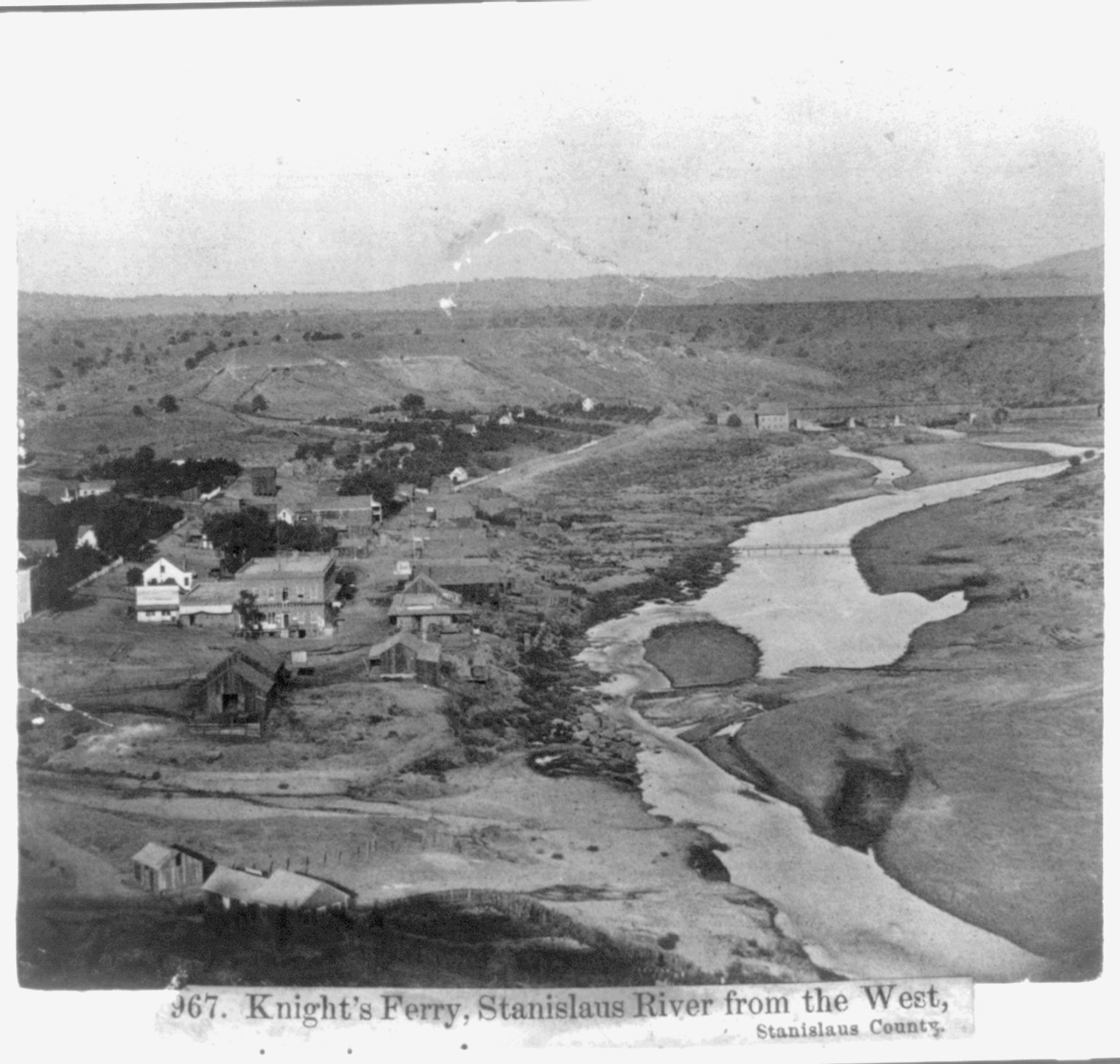
Feature image: Knight’s Ferry, Stanislaus River from the West, Stanislaus County. Stanislaus River from the West, Stanislaus County. 1866. Lawrence and Houseworth. Call number: LOT 3544-24, no. 967. Library of Congress. Public Domain. Accessed via Wikicommons. Support the Wikimedia Foundation here.

You must be logged in to post a comment.