
THIS PAGE ENGAGES WITH HISTORICAL MATERIAL WHICH MAY CONTAIN RACIALIZED LANGUAGE AND DEPICTIONS ROOTED IN HISTORICAL PREJUDICE, OR REFERENCES TO INDIVIDUALS AND COMMUNITIES SUBJECTED TO COLONIAL VIOLENCE.
PLEASE READ OUR ACKNOWLEDGMENT OF HARMFUL CONTENT.

THIS MICROHISTORY TAKES PLACE ON OR INVOLVES THE ANCESTRAL LANDS OF THE MIWOK (MIWUK; MI-WUK; ME-WUK) PEOPLE OF CALIFORNIA, INCLUDING THE CENTRAL SIERRA MIWOK AND NORTHERN SIERRA MIWOK (ME-WUK).
T.GB.1859.2 is a Tracks entry which refers to the presence of “quite a number” of active grizzly den sites on and around Bear Mountain, and the adjacent Calaveras River system on or about the 23rd of November, 1859. It positions these den sites at a midway point between Salt Spring Valley, a mining settlement and San Andreas, California in the United States associated with predominantly-French settlement near the Bear Mountain Range in the Sierra Nevada Mountains.1 This microhistory is descriptive of “sign” of a predator population or individual, but in which no visual record or physical encounter occurs, and is so classed as a Tier 3 event.
T.GB.1859.2 interlinks with the primary source bases of the contemporaneous entries T.GB.1859.1 and GB.1859.1, an adult Grizzly Bear killed on or about 18 November,1859, which corresponds to the racialized, sensationalized distribution of GB.1859.1’s connections to the Chinese-American community. It interlinks with these primary source bases to provide evidence for the continued presence of den sites in this location beyond the bounds of GB.1859.1’s microhistory, and notes the extends the area in which den sites have been seen to an additional geographic position between Salt Spring Valley and San Andreas.
T.GB.1859.2 divulges further details pertaining to the historical ecology of Bear Mountain, and further speaks to the presence of active hunting near Salt Spring Valley and San Andreas. It describes geographic and environmental details of several den site features relevant to modern Grizzly populations, including elevation and slope, availability of thermal cover, proximity to fresh water, and a protected den aspect which can be used to better historicize historical populations.2 This source base places multiple human actors, social groups, and extractive industries in proximity to grizzly communities displaying “predenning” or denning behaviours typical of autumn, late autumn and early winter which precede the winter rest period (torpor sleep, or “hibernation”) of winter.3

Considered alongside T.GB.1859.1 and GB.1859.1, this microhistory further contextualizes the presence of mining and prospecting industries, their associated infrastructure and labourers. In particular, the geographic and temporal proximity between this microhistory and the gold prospecting activities of Mark McNicholas at the summit of Bear mountain, as well as the water infrastructure and management operations of the Calaveras Water Company may offer further context to this history.4
No individual animal’s sex, maternity status, or health is inferable from this microhistory, but the proximity of this predator community to extractive activities and settlement can be read in dialogue with predator populations subject to the negative effects of habitat inaccessibility or alteration on overall population health and reproductive outcomes.5 The racialization underlying the sensationalized distribution of GB.1859.1’s microhistory for its relation to the Chinese-American community discloses the presence of hunters “enjoying a rich harvest of sport” further contributive to these outcomes, and divulged the specific location of a predator community to a wider audience of potential hunters (figures 3-9, below).6


FIGURES 3-9 (FROM LEFT TO RIGHT) IN THIS GALLERY ARE COURTESY OF THE CALIFORNIA DIGITAL NEWSPAPER COLLECTION (CDNC), CENTER FOR BIBLIOGRAPHIC STUDIES AND RESEARCH, UNIVERSITY OF CALIFORNIA, RIVERSIDE. PUBLIC DOMAIN. SUPPORT THEM HERE.
These sources offer further context on relational aspects of climate history, weather and the role of the elements which shape microhistories of the California Interior Chaparral and Woodlands and Sierra Nevada Forests ecoregions (and the related Mediterranean Forests, Woodlands and Scrub biome) and may hold implications for historical den site selection within these regions. Their interlinked details describe the presence of rain, local flooding, and a resulting, high water table potentially involving snow runoff triggered by unseasonably warm temperatures and heavy snow at higher altitudes that season which offer significant context towards understanding historical denning behaviours.7 They offer primary source accounts of animal movement responsive to seasonal and climatological fluctuations, historicizing the meteorological and climatological basis of the presence of Bears and prey species relevant to them (such as deer and other “large game”) in closer proximity to American settlement, and provide further context as to the historical presence of other wild animal and plant populations of the Calaveras River and the Sierra Nevada Mountains, including chaparral, likely signaling the historical presence of a keystone plant population.8
The geographic locus and contextual details provided in this microhistory suggest further potential dialogue with the history of the California Grizzly, an extinct subtype of Grizzly or North American Brown Bear with critical relationships to 19th Century settlement, ranching, and hunting.9 Additionally, the description of “bear” alongside mention of “grizzly bear” in the sources to which this microhistory relates may suggest the presence of the American Black Bear and its associated subtypes.10 Should future context support this, the interlinkage of this microhistory with both T.GB.1859.1 and GB.1859.1 may suggest a historical incidence of sympatry, an ecological condition which describes the presence of two distinct but related species in the same environment, potentially encountering one another as a result of their overlapping habitats.
This microhistory involves neither human fatality nor known injury, is not known to involve livestock animals, and has no known association with bloodsport. The involvement of domestic or companion animals is unknown.
The sources or actors in this microhistory are in dialogue with the following microhistories on pmn:
Notes:
- Julia Costello, “Salt Spring Valley,” CalaverasHistory.org, 2025; Judith Marvin, “The French of Salt Spring Valley,” CalaverasHistory.org, ca. 1994, (accessed 2025).
- Lana M. Ciarniello, Mark S. Boyce, Douglas C. Heard, and Dale R. Seip, “Denning Behavior and Den Site Selection of Grizzly Bears along the Parsnip River, British Columbia, Canada,” Ursus 16, no. 1 (April 2005): 47–58.
- For more details, see “5 Stages of Activity and Hibernation.” North American Bear Center.
- “San Andreas.” San Joaquin Republican, November 20, 1859, Vol. IX, no. 276.
- Claudia López-Alfaro, Charles T. Robbins, Andreas Zedrosser, and Scott E. Nielsen, “Energetics of Hibernation and Reproductive Trade-Offs in Brown Bears,” Ecological Modelling 270 (December 2013): 1–10; Welf Petram, Felix Knauer, and Petra Kaczensky, “Human Influence on the Choice of Winter Dens by European Brown Bears in Slovenia,” Biological Conservation 119, no. 1 (September 2004): 129–136.
- “San Andreas.” San Joaquin Republican, November 20, 1859, “Grizzly Killed.” Sacramento Daily Union, November 21 1859, Volume 18, Number 2699; “Gold on Bear Mountain.” Sacramento Daily Union, November 21 1859, Volume 18, Number 2699; Daily National Democrat, November 23 1859, Volume 3, Number 88; “Value of Bear Gall.” Daily National Democrat, December 14 1859, Volume 3, Number 105; San Joaquin Republican, December 21 1859, Volume IX, Number 301; “Value of Bear Gall.” Nevada Democrat, December 21 1859, Volume 7, Number 12; “Bear Gall.” Petaluma Weekly Argus, January 6 1860, Volume 5, Number 21. These articles accessed and included courtesy of the California Digital Newspaper Collection (CDNC), Center for Bibliographic Studies and Research, University of California, Riverside.
- Karine E. Pigeon, Gordon B. Stenhouse, and Steeve D. Côté, “Drivers of Hibernation: Linking Food and Weather to Denning Behaviour of Grizzly Bears,” Behavioral Ecology and Sociobiology 70, (October 2016); Katherine A. Kurth, Katherine C. Malpeli, Joseph D. Clark, Heather E. Johnson, and Frank T. van Manen, “A Systematic Review of the Effects of Climate Variability and Change on Black and Brown Bear Ecology and Interactions with Humans,” Biological Conservation 291 (March 2024): 110500.
- California Chaparral Institute. “Old-growth Chaparral.”
- Alexis M. Mychajliw et al., “Coupled Social and Ecological Change Drove the Historical Extinction of the California Grizzly Bear (Ursus arctos californicus),” Proceedings of the Royal Society B: Biological Sciences 291, no. 2014 (2024): 20230921.
- Daily National Democrat, November 23 1859.
Cite This Page
Chicago
Caroline Abbott. “T.GB.1859.2.” Predator Microhistory Network. Accessed [Month, Day, Year]. https://predatormicrohistorynetwork.org/2025/05/31/t-gb-1859-2/.
MHRA
Caroline Abbott, ‘T.GB.1859.2’, Predator Microhistory Network, https://predatormicrohistorynetwork.org/2025/05/31/t-gb-1859-2/. [Accessed Day Month Year]
MLA
Abbott, Caroline. “T.GB.1859.2.” Predator Microhistory Network, 31 May 2025, https://predatormicrohistorynetwork.org/2025/05/31/t-gb-1859-2/. Accessed Day Month Year.
APA
Abbott, C. 2025, May 31. T.GB.1859.2. Predator Microhistory Network. https://predatormicrohistorynetwork.org/2025/05/31/t-gb-1859-2/.
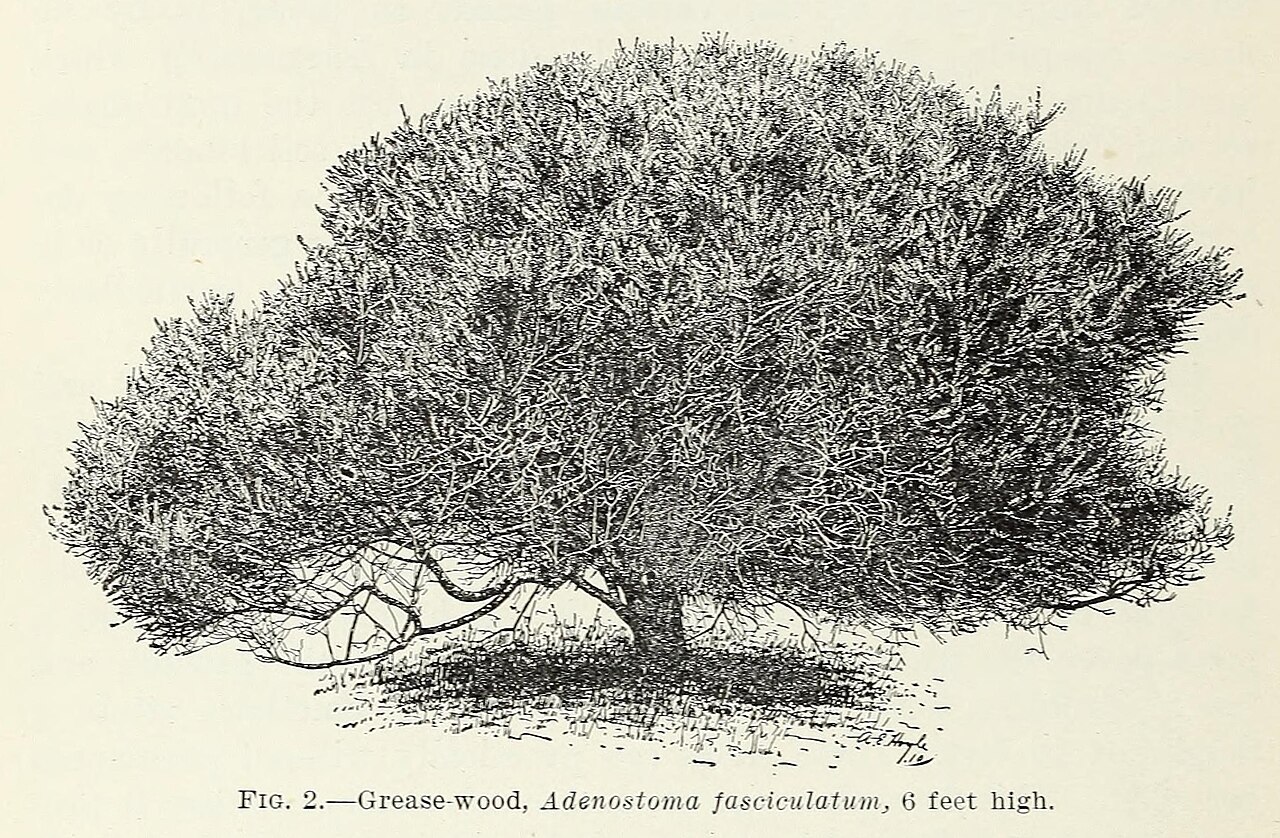
Feature image: Chaparral. Text figure 2. Grease-wood, Adenostoma fasciculatum, 6 feet high. Plummer, F. G. Chaparral: studies in the dwarf forests, or elfin-wood, of southern California. United States Forest Service Bulletin No. 85. July 17, 1911. Accessed via Wikicommons. Public Domain. Support the Wikimedia Foundation here.

You must be logged in to post a comment.