

Fig.1: “A Grizzly Killed,” Sacramento Daily Union, May 22 1860, Volume 19, Number 2856 (Sacramento, CA). Courtesy of the California Digital Newspaper Collection (CDNC), Center for Bibliographic Studies and Research, University of California, Riverside. Public Domain. Support them here.
THIS MICROHISTORY TAKES PLACE ON OR INVOLVES THE ANCESTRAL LANDS OF THE MAIDU (INCLUDING THE MOUNTAIN MAIDU), WASHOE, NISENAN, CAYUSE, UMATILLA, AND WALLA WALLA PEOPLE OF CALIFORNIA.
GB.1860.1 was an adult male Grizzly Bear killed near Jamison, Plumas County, California in the United States on or about May 13 1860. This Bear’s history is defined by two microhistorical events attributed to a single predator to which this page refers. Jump to: 12 May, 13 May, or 14 May on this page for descriptions of the events of each date, jump to context, or scroll to read chronologically.
As an encounter which describes an animal’s death, this Bear has been assigned a Unique Animal Number (UAN). Both events in this Bear’s history represent an encounter which impacts one or more predator agency physically, and is so classed as a Tier 1 event.


FIGS. 2 AND 3: DETAIL FROM KEDDIE’S MAP OF PLUMAS COUNTY, CALIFORNIA, KEDDIE, ARTHUR W. (ARTHUR WALTER), 1892. JAMISON CITY CAN BE SEEN TO THE LEFT OF THE CENTERFOLD IN THE CLOSER IMAGE. LIBRARY OF CONGRESS. PUBLIC DOMAIN VIA WIKICOMMONS. Support the Wikimedia Foundation Here.
May 12 1860
“Having nothing but a short dirk knife, he seized the bear by the tongue”
On May 12, 1860, a party of three men and at least one dog hunting near Jamison, California in the United States “unexpectedly roused” GB.1860.1, a precondition typical of human-bear conflict.1
The party fired on the adult male Grizzly Bear with six shooter revolvers, after which point the wounded GB.1860.1 displayed a typical grizzly defensive response and charged the men. As the other two unnamed party members fled, Joshua Herrington attempted to fire, at which point the “cap on his gun snapped.”2 Following the failure of his firearm, Herrington attempted to escape, “stumbled over a log,” and was pushed to the snow-covered ground by the charging GB.1860.1.3 Herrington “thrust his left hand in the animal’s mouth and grasped the tongue,” and “unsheathed his [dirk knife]” with his right with which he stabbed GB.1860.1, bending or breaking the blade on either the Bear’s paw or ribs, “rendering it useless.”4
Herrington‘s decision to grasp GB.1860.1’s tongue and drag it “through the corner of [the Bear’s] mouth,” likely saved his life.5 With a tongue badly wounded, GB.1860.1 “could use his paws only.”6 When Herrington’s hand ceased to function, he “played dead” as GB.1860.1 “moved off some distance” at which point a “small dog belonging to the party” then attacked GB.1860.1, who ignored the animal and “again approached” Herrington.7 GB.1860.1’s noted effort to lap at Herrington’s face before retreating again may suggest some degree of remaining functionality in the Bear’s tongue. The other two men returned to render aid to Herrington on GB.1860.1’s final retreat, finding the man partially buried beneath the snow.
Herrington sustained severe injuries to his head and scalp, thigh, and left hand. He was brought to town, ostensibly, Jamison, where he received medical attention in in the care of unnamed parties. Reprinting the Sierra Citizen article published on an unknown date in May of 1860, the Daily Alta reported on the 29th that Herrington was “lying at Penman’s,“ likely a reference to Penman’s Ranch several miles north of Jamison and was expected to recover.8 Herrington is not known to have died from his injuries.
GB.1860.1 survived the events of 12 May 1860 and escaped the party, but, like Herrington, was badly wounded: shot multiple times, stabbed in the abdomen or paw, and with a significant oral injury. This microhistory provides pretext for human retaliation motivated by human injury in the event to follow.
GB.1860.1: May 13 1860
“The grizzly was large, but being quite poor he weighed only five hundred pounds”
On May 13, 1860, a party of hunters dispatched from Jamison, California in the United States in search of GB.1860.1, but failed to track the wounded adult male Grizzly as Herrington continued to receive medical care.9 Following their return, “a third party was formed,” which, evidently later the same day or on 14 May, succeeded in tracking and killing GB.1860.1.10
Sources noted that GB.1860.1 was in poor health or condition at time of death. Beyond the recent wounds, GB.1860.1 weighed 500-600lbs (226-272kg). While this is an average weight for a modern adult male Grizzly, the geographic locus of GB.1860.1’s microhistory should be considered alongside the history of the California Grizzly, a larger, extinct subtype of Grizzly or North American Brown Bear with critical relationships to 19th Century settlement.11 This context may add credence to the source analysis of GB.1860.1’s low weight or body fat. GB.1860.1’s hind paw width of 7in (18cm) and length of 11in (28cm) may add further context to the available weight data. GB.1860.1’s unspecified “poor condition” and locality to the town of Jamison may add future context to this microhistory’s relationship to starvation symptoms or proximity as factors in its chronology and outcome.12


Figs. 4-7: “Terrible Fight With a Grizzly,” Hydraulic Press, May 26 1860; “City Items: A Bear Story” Daily Alta California, May 29 1860; “A Bear Story,” Nevada Democrat, May 30 1860; “A Bear Story,” Shasta Courier, June 2 1860. Courtesy of the California Digital Newspaper Collection (CDNC), Center for Bibliographic Studies and Research, University of California, Riverside. Public Domain. Support them here.
GB.1860.1’s story was widely circulated in California newspapers from May to June of 1860, including the Daily Alta California, the Hydraulic Press, the La Porte Messenger, the North San Juan Press, Shasta Courier, Sierra Citizen, Nevada Democrat, and the Sacramento Daily Union.13 Many of these sources refer to Hank Smith‘s role as a secondhand informant to the events of the 12th and 13th of May.
Because Herrington is not known to have died from his injuries, GB.1860.1’s microhistory has no known relationship to human fatality. This microhistory is not known to involve livestock animals.
Context

Weapons, including both firearms and blades, place this microhistory in significant social context. While source material does not describe the model, the nature of Herrington’s firearm’s failure strongly suggests the use of a percussion cap firearm.14 It is notable that moments prior to GB.1860.1’s charge, the party writ large is referred to have “wounded [GB.1860.1] with six shooters,” adding credence to the possibility that a six shooter, percussion cap revolver may have been the type of gun in use.15
It is worth noting that this scenario would have offered a remarkably insufficient defense under the best of circumstances. The use of these weapons to fire on a Grizzly Bear may add credence to the possibility that their encounter with GB.1860.1 occurred while the party was in pursuit of other animals, antithetical to sensationalized accounts which claim the party intended to hunt Grizzlies.16 The party’s use of these firearms may also suggest the presence of local, relevant prey species, and add context to the presence of domestic animal involvement such as the party’s “small dog” in nineteenth century hunting practices.17 Additionally, Herrington‘s possession of a dirk knife may suggest affiliation with Scottish or Irish settlers of the American west.
GB.1860.1’s proximity to Jamison interlinks this microhistory with the history of 19th Century extractivist industries such as mining and their associated social groups, including hunters, miners and prospectors.
”It is bearly possible that the whole story is a “sell”— we think not, however.”
Shifts in the narrative can be detected as the story travels through the press (see Figs. 4-7, above). The Nevada Democrat makes reference to the story’s sensationalist nature and heroic elements in their May 30th reprint of the La Porte Messenger article, closing with the line seen above.18
The geographic locus of GB.1860.1’s microhistory suggests the involvement of the Sierra Nevada Forests ecoregion and Temperate Conifer Forests biome, a relationship to the Sierra Nevada Mountains and to the fresh water, Feather River system. Jamison’s relationship to the middle fork of the Feather River and Jamison Creek may offer further environmental context. While this microhistory has no direct relationship to winter rest period, it does intersect the period of normal activity following winter rest, which may help to further historicize the seasonality of this Bear’s relationship to these environments.
These sources establish GB.1860.1’s microhistory as subsequent to that of BB.1860.1, a “Cinnamon Bear,” or subtype of American Black Bear killed near Jamison City, California, in the United States on or about May 9th 1860.19 The interlinkage between GB.1860.1 and BB.1860.1’s microhistories provides important context for Bear ecology and may suggest a historical incidence of sympatry, an ecological condition which describes the presence of two distinct but related species in the same environment likely to encounter one another as a result of their overlapping habitats.
The sources or actors in this microhistory are in dialogue with the following microhistories on pmn:
Notes:
- Parks Canada, Safe Travel in Bear Country: Bears in the Mountain National Parks. DeChano, Lisa M. and Butler, David R. (2002) “An Analysis of Attacks by Grizzly Bears (Ursus arctos horribilis) in Glacier National Park, Montana,” The Geographical Bulletin: Vol. 44: Iss. 1, Article 4.
- “A Bear Story,” Nevada Democrat, May 30 1860, Volume 7, Number 35 (Nevada City, CA).
- Ibid.
- “Terrible Flight With a Grizzly,” Hydraulic Press, May 26 1860, Volume 2, Number 40 (North San Juan, CA).
- “City Items: A Bear Story” Daily Alta California, May 29 1860, Volume 12, Number 149 (San Francisco, CA).
- Ibid.
- “Terrible Fight with a Grizzly,” Sacramento Daily Union, May 29 1860, Volume 19, Number 2862 (Sacramento, CA).
- “City Items: A Bear Story” Daily Alta California, May 29 1860; “History of Estray Valley and the Greenhorn Creek Guest Ranch,” Las Plumas, Vol. 37, No. 2, May 2010. Plumas County Museum Association. Support them here.
- “A Bear Story,” Nevada Democrat, May 30 1860.
- Ibid.
- Alexis M. Mychajliw et al., “Coupled Social and Ecological Change Drove the Historical Extinction of the California Grizzly Bear (Ursus arctos californicus),” Proceedings of the Royal Society B: Biological Sciences 291, no. 2014 (2024): 20230921.
- “A Bear Story,” Nevada Democrat, May 30 1860. These aspects of GB.1860.1’s microhistory have not been included in its cataloguing. Should further detail emerge, this page will be updated, and this footnote will reflect prior versions of this entry.
- Ibid.; “A Grizzly Killed,” Sacramento Daily Union, May 22 1860, Volume 19, Number 2856; “City Items: A Bear Story” Daily Alta California, May 29 1860; “Terrible Fight with a Grizzly,” Sacramento Daily Union, May 29 1860; “Terrible Flight With a Grizzly,” Hydraulic Press, May 26 1860; “A Bear Story,” Shasta Courier, June 2 1860, Volume 9, Number 13 (Redding, CA). Sierra Citizen, May 1860, (Downieville, CA). These articles accessed via the California Digital Newspaper Collection. Courtesy of the California Digital Newspaper Collection (CDNC), Center for Bibliographic Studies and Research, University of California, Riverside. Beyond 1855, the Sierra Citizen has not been digitized via the CDNC, and is equally rare elsewhere. Its citation is meant as a placeholder. The Sacramento Daily Union‘s reference to the North San Juan Press likely refers to the Hydraulic Press. The La Porte Messenger (now The Mountain Messenger) is California’s oldest weekly newspaper, is still in circulation, and has not been digitized.
- Jeffrey Richardson, The Colt Revolver in the American West, subsection “Continuing the Tradition, Forced to Adapt,” ed. Marlene Head, Autry National Center, archived April 22, 2012, Wayback Machine.
- “A Bear Story,” Shasta Courier, June 2 1860.
- “A Bear Story,” Nevada Democrat, May 30 1860. The solitary discrepancy in this aspect of the story occurs in this publication’s reference to the party’s intent: citing the La Porte Messenger, it claims the party had gone out “in search of a grizzly. They found him,” it claims. The original article may add context to this distinction.
- “Terrible Flight With a Grizzly,” Hydraulic Press, May 26 1860.
- “A Bear Story,” Nevada Democrat, May 30 1860.
- Caroline Abbott, “BB.1860.1,” Predator Microhistory Network, June 5 2025.
Cite This Page
Chicago
Caroline Abbott. “GB.1860.1.” Predator Microhistory Network. Accessed [Month, Day, Year].
MHRA
Caroline Abbott, ‘GB.1860.1’, Predator Microhistory Network. Accessed [Day Month Year]
MLA
Abbott, Caroline. “GB.1860.1.” Predator Microhistory Network, 7 June 2025. Accessed [Day Month Year].
APA
Abbott, C. 2025, June 7. GB.1860.1. Predator Microhistory Network.
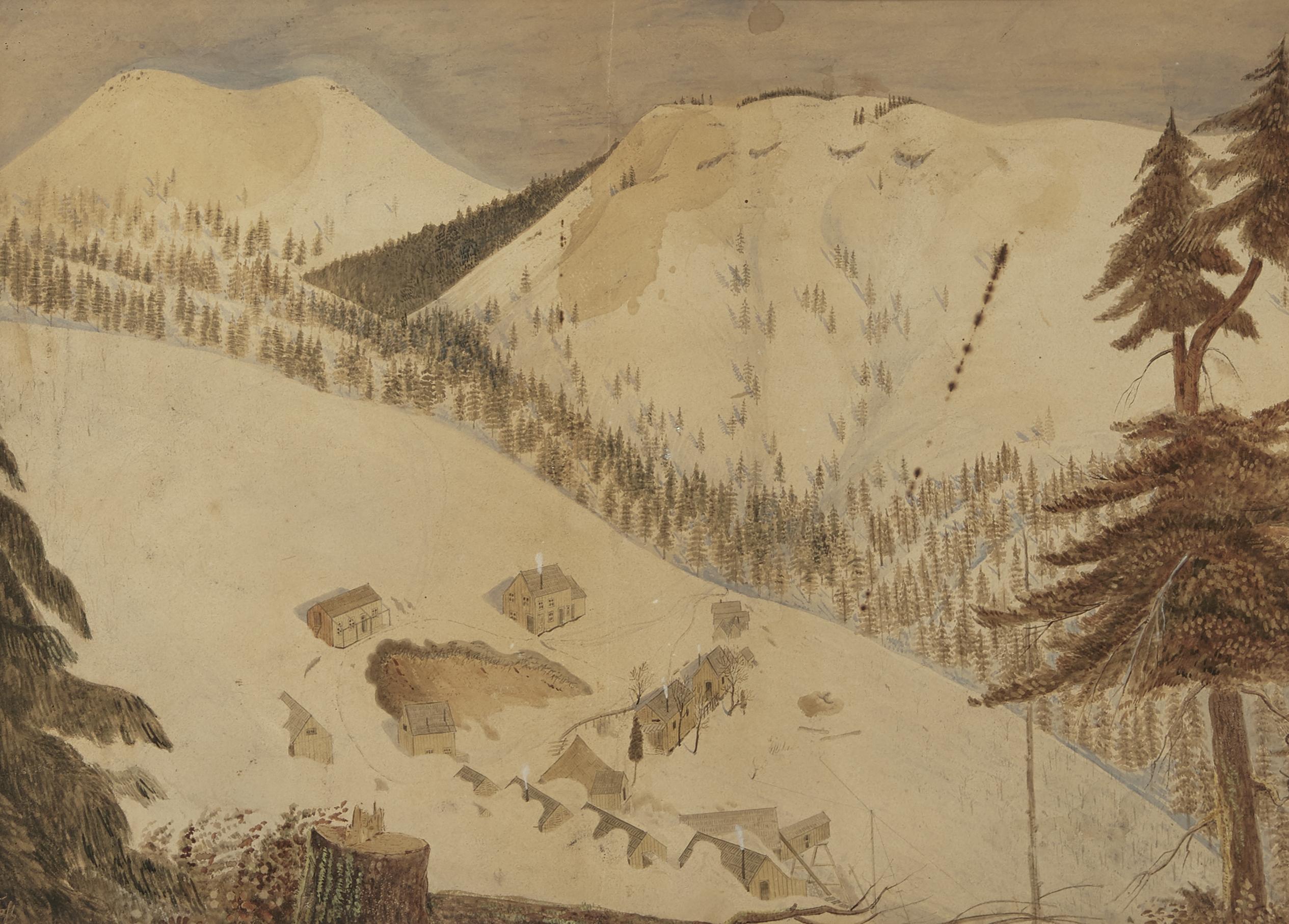
Feature image: A View of Downieville, California in Autumn; A Sierra Gold Mine in Winter, thought to be near Downieville (a group of two) signed ‘P. Peter Toft. c. 1853-1856. Public Domain. Support the Wikimedia Foundation here.

You must be logged in to post a comment.